Showing posts with label history. Show all posts

3.25.2009

Hey, 1999. What the fuck?

Back in the late 1990s Citicorp and Travelers Insurance merged to form Citigroup, currently known as Citi. Citycorp was the successor of the long line of banks started by City Bank of New York in 1812, and Travelers a consortium of insurers and creditors. The merger was unprecedented in its time because those two financial animals—bankers and creditors—were prohibited from sharing assets by the Glass-Steagall Act of 1933. That act separated bankers and brokers in order to prevent the wild speculation that inflated the stock markets leading to the crash of 1929 and the Great Depression.

The act was repealed in 1999 by the Gramm-Leach-Bliley Act, in large part to allow for mergers such as Citigroup to stand. Well guess what:

The repeal enabled commercial lenders such as Citigroup, which was in 1999 then the largest U.S. bank by assets, to underwrite and trade instruments such as mortgage-backed securities and collateralized debt obligations and establish so-called structured investment vehicles, or SIVs, that bought those securities. It is believed that the repeal of this act contributed to the Global financial crisis of 2008–2009.
You can actually go back and read the coverage from the New York Times, including former Treasury Secretary and current White House National Economic Council director Larry Summers's pronouncement that "this historic legislation will better enable American companies to compete in the new economy." But the most significant part of the report is this small prognostication:
"I think we will look back in 10 years' time and say we should not have done this but we did because we forgot the lessons of the past, and that that which is true in the 1930's is true in 2010," said Senator Byron L. Dorgan, Democrat of North Dakota. "I wasn't around during the 1930's or the debate over Glass-Steagall. But I was here in the early 1980's when it was decided to allow the expansion of savings and loans. We have now decided in the name of modernization to forget the lessons of the past, of safety and of soundness."
Now here we are.

2.02.2009

Antique maps of New York City

Here's a map of New York City from 1847. Notice that there are, of course, no bridges and all river crossings were done by ferry. The Greenpoint area of Brooklyn was known as Williamsburg (thus the Williamsburg Bridge). Straight roads dominate except for a few bended streets in the oldest section of lower Manhattan. Half of Broadway was called Bloomingdale Road, and the Harlem Railroad ran all the way downtown.

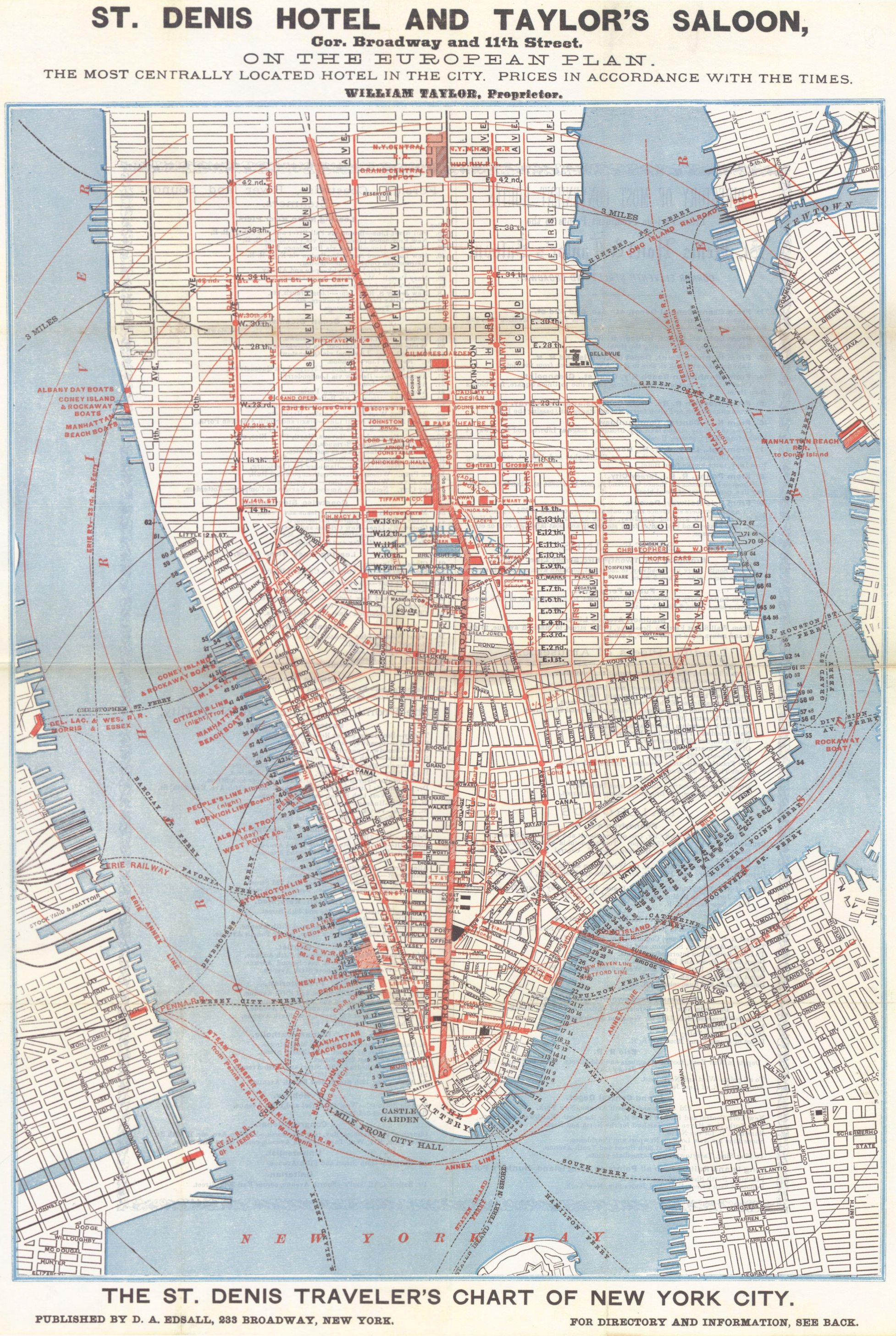
Here's a map from 1879 that offers way more detail. The Brooklyn Bridge opened four years after this map was drawn and it's marked as "Suspension Bridge" (it was officially named Brooklyn Bridge in 1915).

Finally here's a Google Maps view of New York City today. Notice the dominance of highways and tunnels, the reclaimed areas on the west side of Manhattan's tip in the Financial District, the reclaimed docks on Brooklyn's industrial shore, and the various holes in the Lower East Side where roads were closed off for housing developments. The Peter Cooper Village—Stuyvesant Town on the East Side at 14th St. and 1st Ave. is the largest. It was built in the mid-40s over the former Gastown District (where coal gas was processed) as a postwar housing project.

Also notice how the area around the Brooklyn and Manhattan bridge landings in Brooklyn reformed the streets. I was researching this old photo of the Daily Eagle Building a while back and had trouble figuring out if it still stood because the street in the photo no longer exists.

11.07.2008

The Great Hobo Wars


This Ken Burns effect-laden video is almost painful to watch, but the audio is taken from probably the funniest part of John Hodgman's audiobook version of The Areas of My Expertise (audiobook link/paperback link). His new book More Information Than You Require is out now with an audiobook version TBD. Hodgman was interviewed on last Sunday's This Week in Tech by Leo Laporte, hear it here (the interview starts at about the one hour mark and lasts 30 minutes). In the interview he talks about filming the Apple "I'm a Mac"/"I'm a PC" commercials with Justin Long, his books, Yale University and The Daily Show.

(via kottke.org)